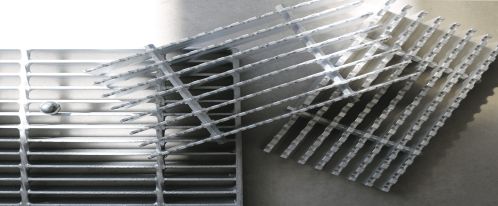
Defining grating in a single sentence is not feasible due to the extensive variety in its construction and the raw materials used.
In general, grating refers to meshed panels made from various materials such as steel, fiberglass, aluminum, stainless steel, and more.
Ajineh Industrial Company of Arak is proud to announce that with nearly twenty years of experience in the grating industry, it has been manufacturing various types of metal gratings and fiberglass gratings.
As mentioned above, there are different types of gratings available.
Metal grating, aluminum , fiberglass , electroforged , and stainless steel are among the types of this product.
Due to Ajineh Industrial Company of Arak’s activities in manufacturing various metal and fiberglass gratings, we will limit our explanation to these types.
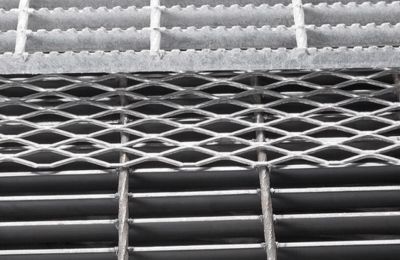
Metal gratings, as the name implies, is made from metal components.
This product is manufactured in three methods and models based on its application and functionality:
Belt-in-Belt Grating:
The most robust and sturdy type among metal gratings, which uses belts in the load-bearing and connecting parts during its production.
Belt-in-Half-Belt Grating:
In this model, the load-bearing part of the grating is made of belts, and the connecting part is made of half-belts.
Belt-in-Rod Grating:
The load-bearing part of this product is made of belts, and the connecting part is made using rods.
In explaining the types of gratings, we mentioned connecting and load-bearing belts, which we deemed necessary to briefly explain:
Connecting Belt:
The connecting belt, which necessarily does not have to be made of belts and can also be made of half-belts, rods, and twisted square bars, holds the load-bearing belts in place and facilitates movement over.
Load-Bearing Belt:
All the load and pressure on the grating are directly on the load-bearing belt.
Therefore, to have a firm and sturdy grating, calculating the thickness, height of the belt, and size of the meshes must be done by specialists in this field.

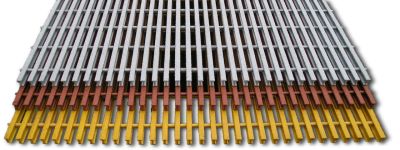
Fiberglass grating is also known as composite grating due to the composite materials and fibers used in its construction.
The manufacturing process of composite grating is entirely different from other gratings, which we will briefly explain.
Depending on the application and location of use, the proportion of raw materials, fibers, and resin is calculated by experts and then poured into a mold.
After the molding process, the curing stage takes place.
Finally, after cleaning, the product is ready to be shipped to the desired location.
This product itself comes in three categories: molded fiberglass grating, covered fiberglass grating, and pultruded fiberglass grating.
The applications of this product include chemical laboratories, food industries, ship decks, treatment plants, refineries, the electricity industry, treatment plants, and many other places.
At the end of discussing what gratings are, it’s important to note that each of the above models has its unique features and applications.
You can contact the sales experts of the company for more information and to choose the best type of this product for your desired location.
The application of gratings can be answered in such a way that nowadays, it is used in almost all industries.
Below, we will introduce some of these industries:
Oil, gas, and petrochemical industries.
Drilling and mining industries.
Steel and copper industries.
Food industries.
Laboratory industries.
Pharmaceutical industries.
Automotive industries.
Shipbuilding industries.
Military industries.
And more.
This product has numerous advantages and features, which is why it is used in many places. Below, we will briefly review the benefits of each of these gratings:
Benefits of Metal Grating:
• High strength and durability.
• Galvanized coating.
• Resistant to deformation.
• Very high safety.
• Easy installation.
• Easy transportation.
• Possibility of temporary and permanent installation.
• And more.
Benefits of Fiberglass Gratings:
• Low weight.
• Reasonable price.
• Easy installation.
• Insulating properties of the gratings.
• Easy transportation.
• Non-magnetic grating.
• And more.
We hope to have provided you with useful information regarding various types of fiberglass and metal gratings.
In addition to manufacturing various types of metal gratings with hot-dip galvanized coating in different sizes and dimensions, Ajineh Industrial Company of Arak has also started producing various types of fiberglass gratings as part of the company’s development plan.
For information on prices and to order your desired product, please contact the company’s sales experts.
Thank you for your companionship.